Posts

Blog#4

  What was your plan for taking the photos? What was the process like during taking the photos? How did they come out? Do you think you'll need to update them in any way? My plan for taking the photos was to take pictures of a Breoanna Taylor and a George Floyd mural to help understand what is being signified or to help give a better representation. I did not end taking the pictures but to be more creative I sketched two murals with    Breoanna Taylor and a George Floyd. The sketches came out better than I expected others looked at them before I presented them. Sketching has to deal with forming the right visual and I redid it a couple times before I even showed it to others and presented to more peoples. There were positive ideas about the sketches I made so I don't think they should be updated.
Blog#3

  How did you take the feedback? What have you worked on since your first sketch? What have you changed? What have you kept the same? I took the feedback very informing and helpful when it comes to making a magazine helped me come up with different designs and help me understand the different elements more. I have worked on the fonts, colors, layout, and alignment since my first sketch and it seems like everything turned out better with my layouts and designs. I really didn't keep anything the same except for my topic and titles because I ready to stand up when it comes up to African Americans especially when it includes racism or discrimination.

Blog#2

  How did you respond to the feedback from your initial proposal? What will you change in your second round of sketches that are due soon?    I responded back to the feedback from my first proposal by listening to the feedback that was given to me and understanding it from a different perspective. There was too much white space and there needed to be more work when it came to the alignment. I will change the layout and design by changing where the picture will be and how small or large the font of the letters will be. Also changing the colors and alignment with the pictures and words being used, and come up with something more creative. 

Blog #1

Image
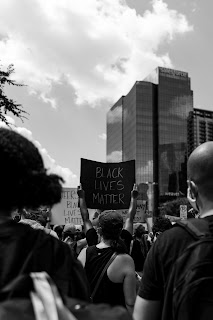
Why did you select this idea for the magazine? What are some similar references you've used that helped you influence your layout and design? Include images of those references.  I selected this idea for the magazine because I wanted more people to be informed when it comes to African Americans we are still excluded from most things and we all may have equal rights now but discrimination is still present in today's society. Others discriminate against African Americans because of how we were treated back in the day and since we don't have those laws that exclude us anymore it seems as if people see us  African Americans as a threat. The similar references I have used that helped me be influenced the layout and design would be looking at different protest pictures or looking at different cases to help.

#WRITINGREFLECTION1

Image
  First off, I would like to say this a very beautiful assignment to complete. Gender is the range of characteristics pertaining to and differentiating between, masculinity and femininity. Not all females want to dress like a girly girl and not all males want to dress masculine. In the video with Judith Butler, it shows the difference between what performed and performative gender is. Performed means gender is there before the performance and performative means that gender is the performance itself. Gender won’t exist until it is performed. Judith Butler stated a good point she states that “Think about how sissy boys or tomboys have to functions around others”. To me, she made a point by saying that because sissy boys are going to be called gay because of how they may dress. People see that it is more feminine clothes so of course others will assume their sexuality. Tomboys are going to get asked if they are lesbian because of how masculine they may be dressed. In this society toda...

Chapter 4 Elements Of Narrative Refelection

  1.T he difference between narration and narrator is that narration is the act of telling a story and a narrator is one who tells the story. 2. The difference between omniscient and restricted narration is that omniscient narration is when everything can be told and unrestricted information provided. Restricted narration is when there is a singular perspective and limited information provide.  3.Part A: The difference between (a) the camera narrator and a third-person narrator is that a camera narrator focuses more on the visual elements such as angles and shots. But a third-person narrator is not a character in the story they are telling. Part B: A first-person narrator and a third-person narrator is first-person deals with hearing one narration while watching the camera's narration and third-person the narrator isn't in the movie 4. A major character can be flat and a minor character can be round because characters it is how the character is characterized. There can be all ...

Chapter 4: Representation Reflection

Image
  The idea of representation has to deal with being based on actual experience and based on an actual reason. Representation also has to also deal with a specific group being labeled and once a specific group is labeled or a stereotype is created for that group others will never look at the group the same because of how much prejudice is built up. According to Chapter 4 Representation, states, " The term has the capacity to suggest that some media  re -present, over and  over again, certain images, stories, situations. This can make them  seem ‘natural’ or familiar – and thereby marginalize or even exclude  other images, making those  un familiar or even threatening." In other words, this evidence is saying once the media is brought up man of times it can make the labeling seem more comfortable to others so, it won't be that hard for someone to make a preconceived opinion on a topic.